Joe Hand's Boxing Gym
I'd Like to Apologize to Every Teacher I Ever HadJoe Hand's Boxing Gym is a nearly new neighborhood boxing facility at the corner of Third and Green that becomes an extension of Tony Danza's classroom. With rings at the front and back, quality heavy and speed bags, a computer room for schoolwork, knowledgeable trainers, and a policy of reduced or free training for local children, the gym offers Northeast High School students something the school itself cannot easily provide: a structured place where physical energy can be redirected, confidence can be earned, and trust can develop through shared work.
Setting and Purpose
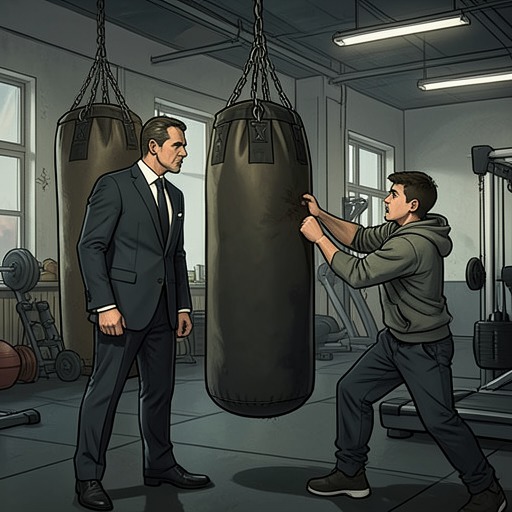
Joe Hand's Boxing Gym belongs to the Philadelphia boxing world associated with Joe Hand, a local promoter who operates a chain of gyms. Its storefront is described as unusually neat and nearly brand new for a city boxing gym. The facility combines athletic and educational functions. Young people can use its computers for schoolwork, while its rings and punching bags support formal training. Joe Hand also waives monthly dues and lets neighborhood children train without charge, making the gym accessible rather than exclusively commercial.
The gym's importance is also personal for Tony Danza. When he sees it while walking home from school, he remembers that boxing once served as his ticket out of trouble and into a new life. Before learning to box, Danza was frequently involved in fights because he was small and felt compelled to prove that he was tough. Boxing changed that relationship to violence: once he knew he could fight, he no longer needed to demonstrate it constantly. The sport also exhausted some of a young person's excess energy, an insight that leads directly to his attempt to help Matt.
The Matt Intervention
By the end of October, Matt is tied for the school's dubious record for fights. After a friend is attacked, Matt fights with African-American students and is then badly beaten by four of the same students. He returns with a bruised, black-eyed face, while his father reports that Matt is both highly energetic and troubled by problems at school. Matt soon says that he is close to expulsion, raising the stakes of Danza's intervention.
Danza enters Joe Hand's Boxing Gym and meets the manager, Petey Pop, and the professional trainer Dan Davis. As he walks around the rings, he feels at home. Although Danza says that he is getting old and has bad knees, Davis persuades him that they can work around the injury. Danza agrees to visit several times a week to hit the mitts and bags, and the gym thereby becomes part of his own renewed connection with boxing as well as part of his work with Matt.
Danza also orders a cobra punching bag for Northeast High School. The reflex bag, mounted on a spring anchored in a sand-filled pedestal, is installed in a small, shabby visitors' locker room across from the football coach's office. He plans to teach Matt during fifth period. The object changes the scale of the intervention: instead of giving Matt only verbal warnings, Danza creates a repeatable physical practice in which speed, coordination, balance, and controlled force matter.
Training, Trust, and Limits
Matt is immediately excited by the plan, especially by the prospect of punching something called the cobra. Other students see Danza carrying the bag and two pairs of gloves through the hallway and follow. Soon about a dozen students, including boys and girls, football players and academically oriented students, are sitting on the locker-room benches to watch. The gym's influence thus travels into the school through equipment, demonstration, and imitation.
Danza shows the students how to make the cobra dance, then performs a seven-punch combination: left jab, right cross, left hook, right uppercut, left hook, right cross, ending with another left hook. The students applaud when he demonstrates that he can still fight. Each student then takes a turn. Some girls perform better than the boys because they are less self-conscious and simply enjoy the activity, while the boys become more competitive. Matt, however, excels. His size and strength, unusual for a fifteen-year-old, allow him to throw himself fully into the workout, and the exercise appears to calm him by giving his pent-up energy a midday release.
Over the following weeks, Danza and Matt go almost every day during fifth period and trade rounds, with Danza making Matt work harder than himself. They also meet at Joe Hand's Boxing Gym, where Matt trains alongside professional fighters including Boogaloo Watts, a famous Philadelphia fighter from Danza's era. Matt shows genuine potential and talent. The training makes him more confident and less dependent on daily displays of toughness, while the shared activity earns Danza his respect and some measure of trust. That trust makes classroom life easier for both of them.
The gym does not provide a miraculous cure. The more time Danza spends with Matt, the more clearly he sees a deep, smoldering anger that has not disappeared. Matt is less explosive but remains unable fully to control himself; on some days he still roams the classroom, touches objects, and elbows friends. Because the relationship has grown closer, Danza expects greater self-control, yet the continued disruptions force him to acknowledge that physical training can support change without resolving every underlying problem.
Conflict Beyond the Gym
Matt's difficulties are embedded in a wider atmosphere of racial tension and confrontation at Northeast High School. After a meeting in which Matt's parents, Danza, a department head, and a counselor agree that Matt will begin regular counseling, Matt's parents encounter a group of Black girls in a crowded corridor. The girls are talking trash and horsing around, using crude language and racial epithets. Matt's father asks them to watch their language, but they insult him and his wife, and the exchange becomes a screaming match.
Afterward, Matt's father tells Danza that the encounter confirms Matt's complaints about Northeast and its students. Danza warns him not to tell Matt that he is right, explaining that the girls' manner of speaking is cultural and shaped by home and media. The father's conclusion threatens to reinforce Matt's sense that the school is divided into hostile groups, whereas Danza is trying to prevent anger from becoming a settled interpretation of the world. Matt's parents agree to let him finish the year but plan to send him to a Catholic school the following year; Danza reluctantly admits that parochial discipline may be what Matt needs.
Narrative Significance
Joe Hand's Boxing Gym stands between several worlds: school and neighborhood, sport and education, aggression and self-command, adult memory and adolescent possibility. It is not presented as an escape from institutional problems, since Matt still needs counseling and remains vulnerable to racialized conflict and expulsion. Its value lies instead in the relationships and practices it makes possible. A free or affordable gym, a computer room, professional trainers, and a cobra bag in a neglected locker room together create an environment in which participation can precede explanation.
The gym also enlarges Danza's identity as a teacher. His history as a boxer gives him a language Matt recognizes, but the intervention succeeds only when boxing becomes sustained companionship rather than a single performance. Rounds, repetition, effort, and the presence of real professionals help Matt experience competence without requiring him to prove his toughness through fights. Joe Hand's Boxing Gym therefore becomes one of the book's clearest examples of education occurring outside conventional instruction: through the body, through trust, and through the disciplined transformation of energy.